

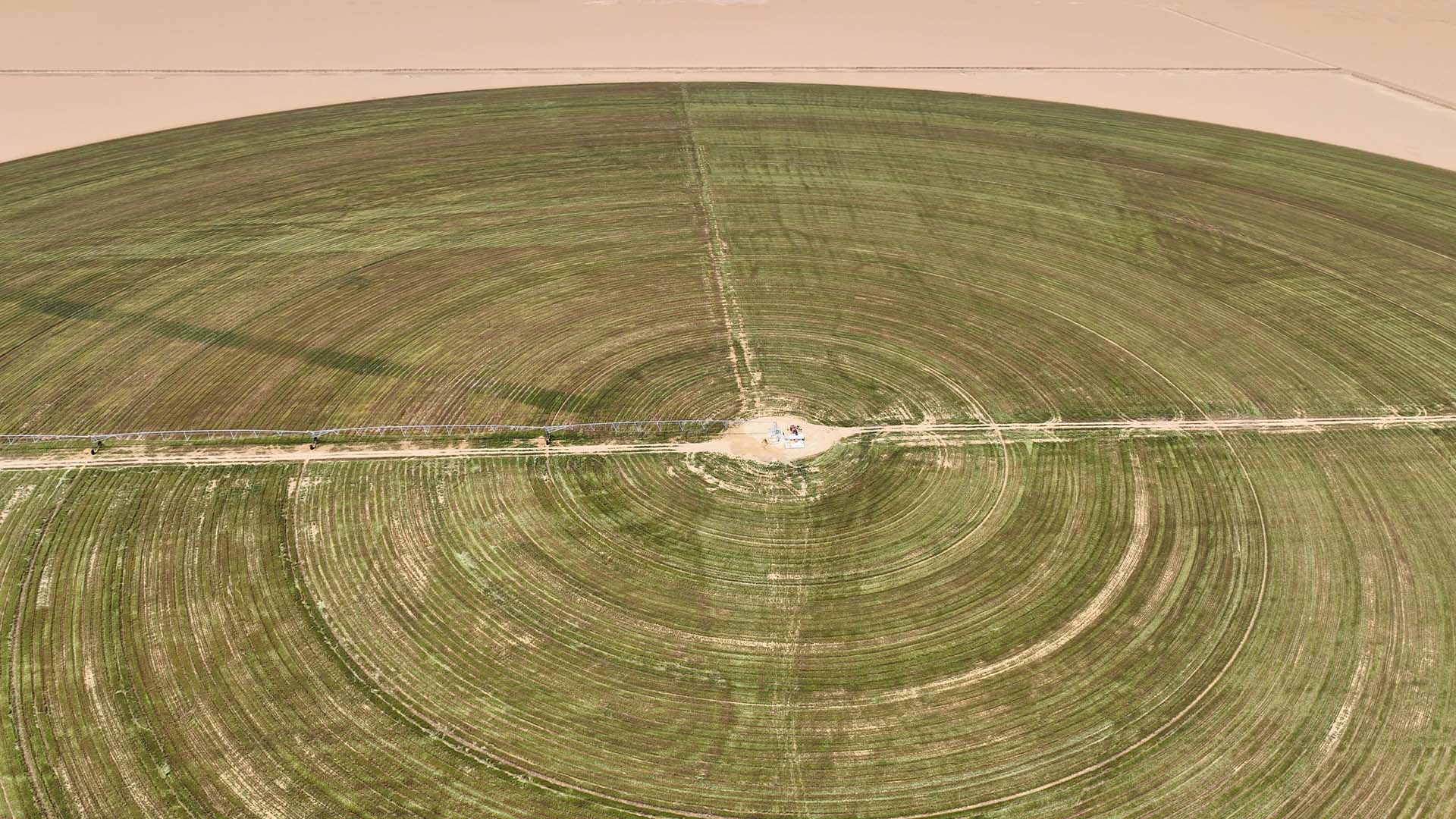
Egypt is pushing ahead with an irrigation project expected to cost at least $15 billion and convert 924,000 hectares (2.28 million acres) of desert into farmland, seeking to curb food imports as population growth strains the country’s limited water supplies.
Known as New Delta, the development will move water through 114 kilometers (71 miles) of canals and pipelines west of the Nile delta, creating what Egyptian authorities describe as the world’s largest artificial river. It is a centerpiece of President Abdel Fattah el-Sisi’s Egypt Vision 2030 program and the country’s largest agricultural expansion drive.
Announced in 2021, the project is a signature initiative of el-Sisi, who has been in office since 2014. The government says it will increase domestic food production, support processing plants and expand agricultural exports.
Desert covers about 96% of Egypt, while its arable land has declined by around 2% a year since the 1990s because of desertification and urban expansion.
The country’s population, the largest in the Arab world, is approaching 120 million and is expected to reach 165 million by 2050, according to the World Bank.
Egypt imports about 40% of its food needs, according to the United Nations Food and Agriculture Organization.
The country imported 13.3 million metric tons of wheat in 2025, against estimated annual demand of 20 million metric tons, according to Fastmarkets. Between 2017 and 2022, Russia and Ukraine supplied 82% of Egypt’s wheat purchases, Reuters reported.
The war between those countries disrupted the trade route, forcing Egypt to buy from other suppliers at a 40% premium. Imports of other food products reached 15 million metric tons in 2024 at a cost of $19 billion, according to the government.
Antonio Cabrera, a former Brazilian agriculture minister and president of Cabrera Group, recently visited Egypt and reviewed details of the New Delta project. His group operates in the soybean, coffee and beef industries.
“In Brazil, productivity starts with the seed. There, it starts with water,” Cabrera said.
The new farms are expected to produce mainly wheat and corn, as well as vegetables, fruit and herbs. The plan calls for partnerships with about 150 companies.
Egypt also wants to double agricultural exports to 13 million metric tons by 2030 from 6.5 million metric tons in 2022. Export revenue is targeted to rise to $7 billion from $3.3 billion, with the European Union, the Middle East and Africa as the main markets.
Water scarcity
New Delta is not Egypt’s first attempt to expand farming despite severe water constraints. Agriculture in the country has been shaped by water scarcity for thousands of years.
Between 2015 and 2020, Egypt irrigated 500,000 hectares (1.24 million acres) along the fringes of the Nile, creating circular fields across the desert. The expansion increased production but was not enough to keep pace with rising food demand.
Regional geopolitics added to the pressure. In 2011, Ethiopia announced a $5 billion hydroelectric project on the Nile that was intended to double the country’s electricity generation and extend power supplies to 60% of its population.
Egypt opposed the dam, arguing that filling its reservoir would reduce downstream flows. The dispute escalated to an Egyptian threat to strike the dam after mediation attempts at the United Nations failed.
The original account says the power project was abandoned while the dam remained in place, and that lower Nile flows added urgency to New Delta.
Canals, pipes and pumps
The New Delta water route begins with a 50-kilometer (31-mile) artificial river running from the northern end of the Rosetta branch of the Nile delta.
Rosetta is one of the delta’s two remaining branches, alongside Damietta. Five other branches disappeared as a result of desertification.
The canal will connect to about 25 kilometers (16 miles) of underground pipelines, followed by roughly 40 kilometers (25 miles) of above-ground pipes.
Part of the canal is already complete and has carried water since June 2024. Sections of both the underground and above-ground pipeline networks have also been built.
More than 20 pumping stations are designed to move the water to the Al Hammam treatment plant. Completed in 2023, the facility recycles 7.5 million cubic meters of water a day and is the world’s largest plant of its kind, according to Egypt.
From there, the treated water will supply irrigation networks across the farming areas, supplemented by an underground water reserve.
The project also includes roads, grain silos and energy infrastructure. Cabrera said its proximity to major highways, ports and airports should support agricultural and food-processing logistics.
The 924,000-hectare New Delta tract forms part of a broader plan to increase Egypt’s cultivated area to 6.3 million hectares (15.56 million acres) by 2030 from about 3.97 million hectares (9.81 million acres) today. That would add almost 2.4 million hectares (5.93 million acres).
Major challenges remain. Egypt still lacks the technology needed to desalinate water from the underground reserve, while the desert soil requires extensive preparation and fertilizer.
Questions also remain about the engineering capacity and labor mobilization needed to operate in the desert. The project has also drawn environmental criticism.
This story was translated from the original Portuguese with the assistance of artificial intelligence and reviewed by The AgriBiz editorial staff.